Grading 101: PSA, CGC, TAG, WTF?
Five labels, four scales, two kinds of 10. What the number on the slab means, grader by grader, and why a PSA 9 and a CGC 9 are not the same card.
 The Collectibles6 min read
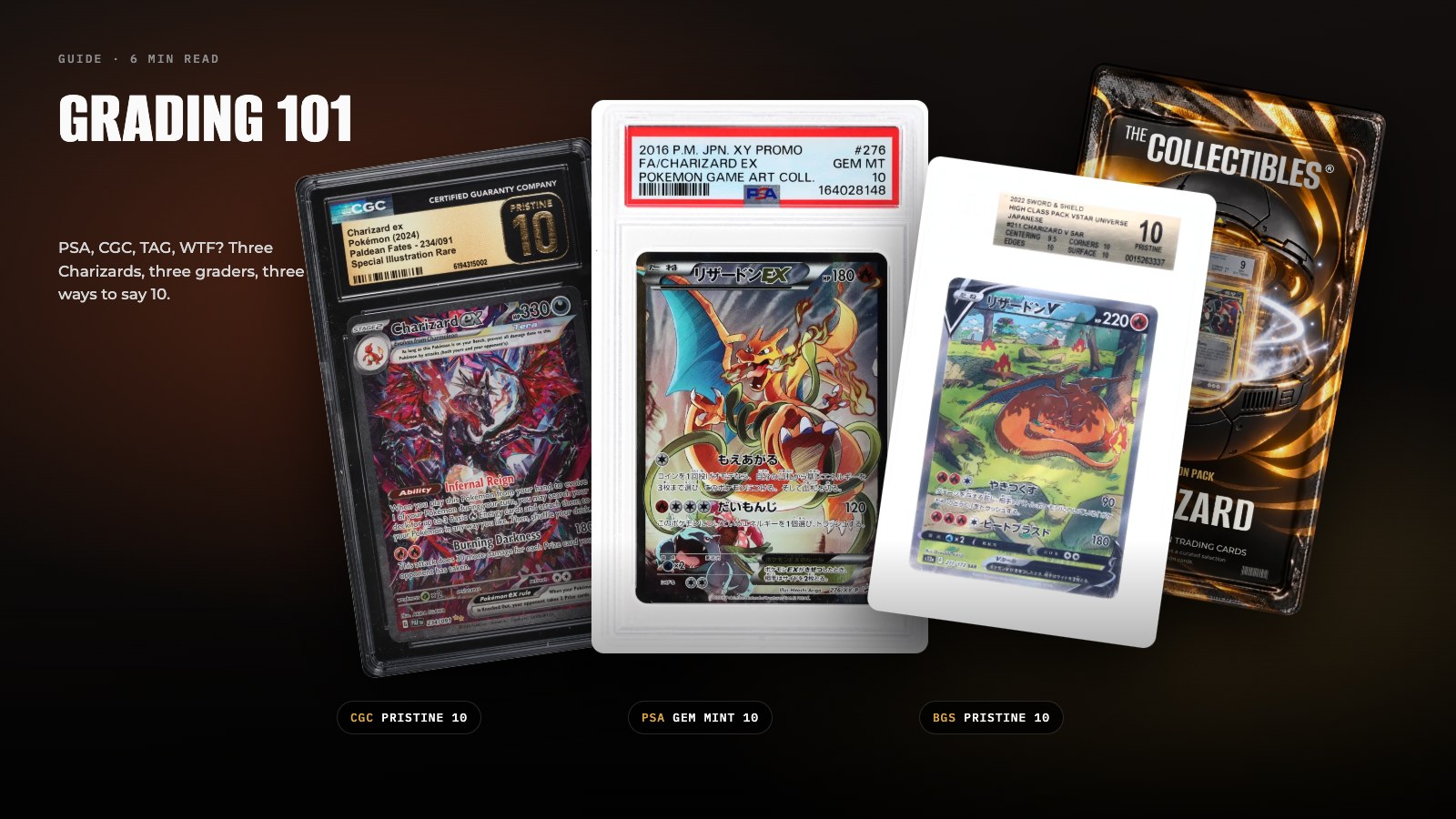
What does a card grade mean?
A graded card is a card somebody else has looked at under magnification, given a number, and sealed in plastic with a label and a certificate number. The number is the grade. The plastic is the slab. The company is the grader, and there are more of them than most people think.
The grade sets the price. The same card can cost several times more as a 10 than as an 8, and the step from 9 to 10 is usually the biggest one on the ladder. So it matters which grader gave the number, because the graders do not use the same scale.
PSA vs BGS vs CGC vs SGC vs TAG: the grading scales compared
| Grader | Scale | Top grade | Subgrades | What to know |
|---|---|---|---|---|
| PSAUSA · 1991 | 1 to 10. Half grades from 1.5 to 8.5; there is no 9.5. | PSA 10 Gem Mint | None | The price reference. Most sales data, most population data, the red label everyone recognises. |
| BGSBeckett · 1999 | 1 to 10 in half points. | 10 PristineBlack Label 10 = all four subgrades at 10 | Four, printed on the label: centering, corners, edges, surface | A 9.5 is Gem Mint. The subgrades tell you why a card got its number. |
| CGCUSA · 2020 for cards | 1 to 10 with half grades. Older 9.5s count as Gem Mint 10. | Pristine 10 (flawless at 10×, 50/50 centering) above Gem Mint 10 (centering up to 55/45) | No longer offered on most submissions | The Perfect 10 was retired; those cards were reholdered as Pristine 10. Blue label. |
| SGCUSA · 1998 | 1 to 10 with half grades. | 10 Pristine (50/50) above 10 Gem Mint (up to 55/45) | None | The black “tuxedo” holder. Big in vintage sports, growing in Pokémon. |
| TAGUSA · computer vision | A 1,000-point score mapped to 1 to 10, half points except between 9 and 10. | Pristine = 990 to 1,000TAG 10 = 950 to 989 | A full defect report per card (the DIG report) | Shows its work: every slab links to the scan and the exact score. Under 1 % of cards reach Pristine. |
| ACEUK | 1 to 10 in half points. | ACE 10 | None | The UK grader. Known for a tight centering rule on its 10. |
| ARSJapan | 1 to 10. | 10+ for a card perfect on every criterion | None | The Japanese market’s grader; common on Japanese promos. |
What is the difference between PSA 10 and CGC 10?
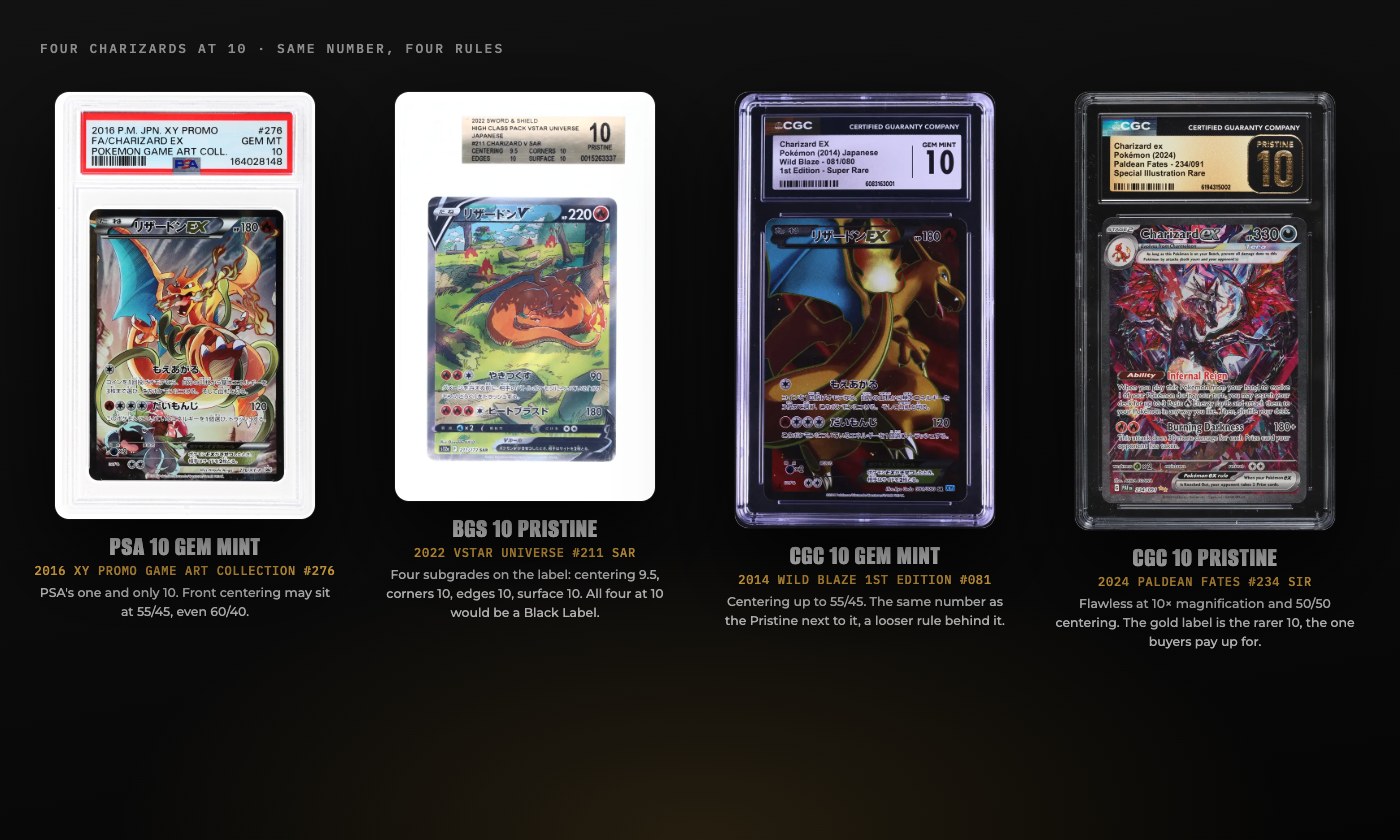
PSA has one 10, Gem Mint, and allows a slightly off-centre front, 55/45 to 60/40. CGC has two: Gem Mint 10, centering up to 55/45, and Pristine 10, flawless at 10× magnification with 50/50 centering and a gold label. So a CGC Gem Mint 10 is roughly a PSA 10’s equal on paper, and a CGC Pristine 10 is stricter. On price, a PSA 10 still usually sells for more, and the gap is widest on vintage cards; on modern cards it has narrowed, and the sold listings for the exact card decide.
Is a CGC Pristine 10 better than a PSA 10?
As a grade, yes: it asks for perfect centering where PSA does not. As a price, it depends on the card and the buyer. Vintage buyers pay for the PSA label; a Pristine 10 of a modern card can sell above the PSA 10 of the same card because far fewer exist. Check both before you choose where to grade.
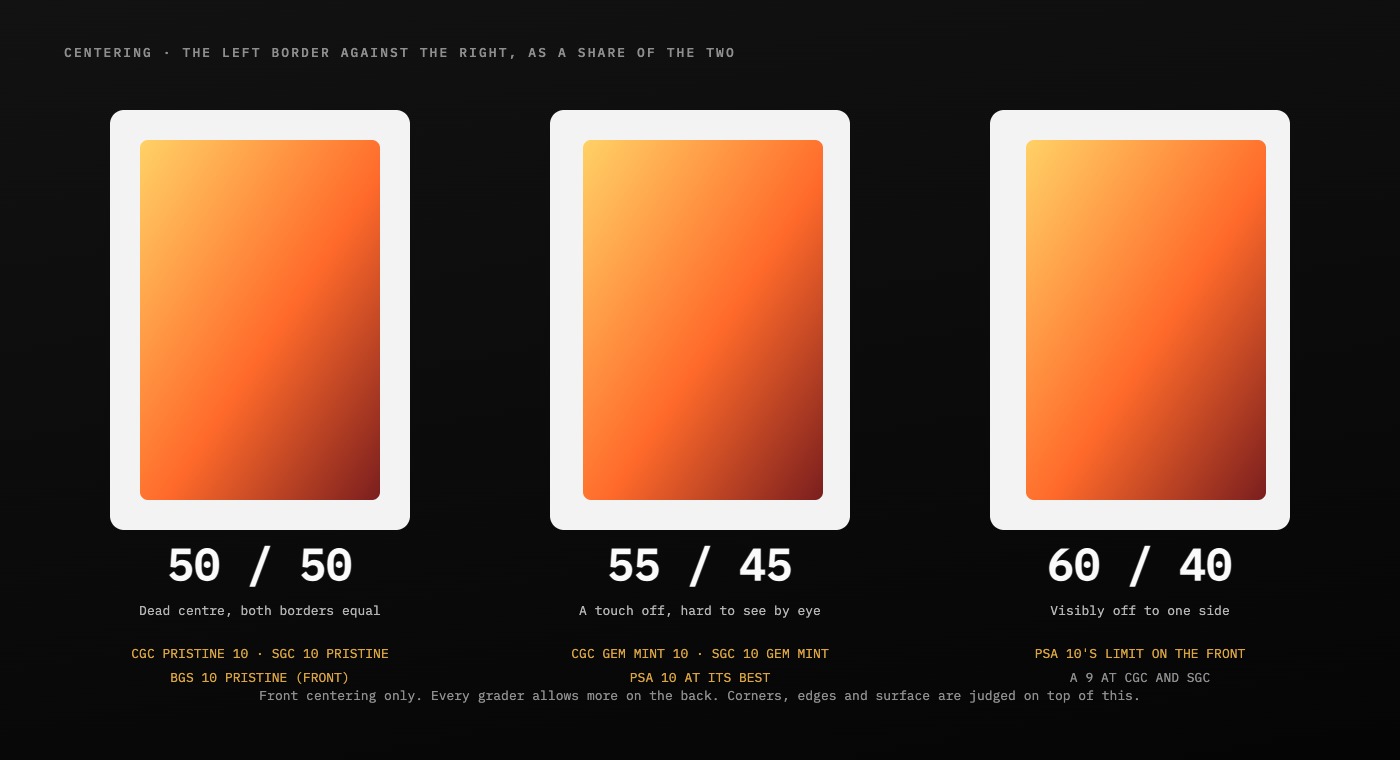
Centering decides more 10s than anything else. A PSA 10 allows a slightly off-centre front; a CGC or SGC Pristine 10 wants 50/50. That is the main reason a card can be a 10 at one grader and a 9 at another.
What do BGS subgrades and a Black Label mean?
Four subgrades on the label. BGS prints centering, corners, edges and surface beside the grade, so the label says why a card got its number. A 9.5 is Gem Mint. A 10 Pristine needs every subgrade at 9.5 or above with the average at 10, and a Black Label is all four at 10, the rarest label in the hobby. SGC and TAG each have a Pristine above their Gem Mint 10 as well, for a card that is perfect rather than nearly perfect.
Why is there no PSA 9.5?
PSA added half grades in 2008 for 1.5 to 8.5 and kept 9 and 10 whole: a card is either Mint or Gem Mint. BGS, CGC and SGC grade a 9.5; TAG has no half point between 9 and 10 either, it has a 1,000-point score instead.
How do I check a PSA, CGC or BGS cert number?
The certificate number is the part worth checking. Every grader lets you type it into their site and see the card they graded, so a label on the wrong card, or a fake slab, shows up in ten seconds. Do it before you buy a slab from anyone you do not know.
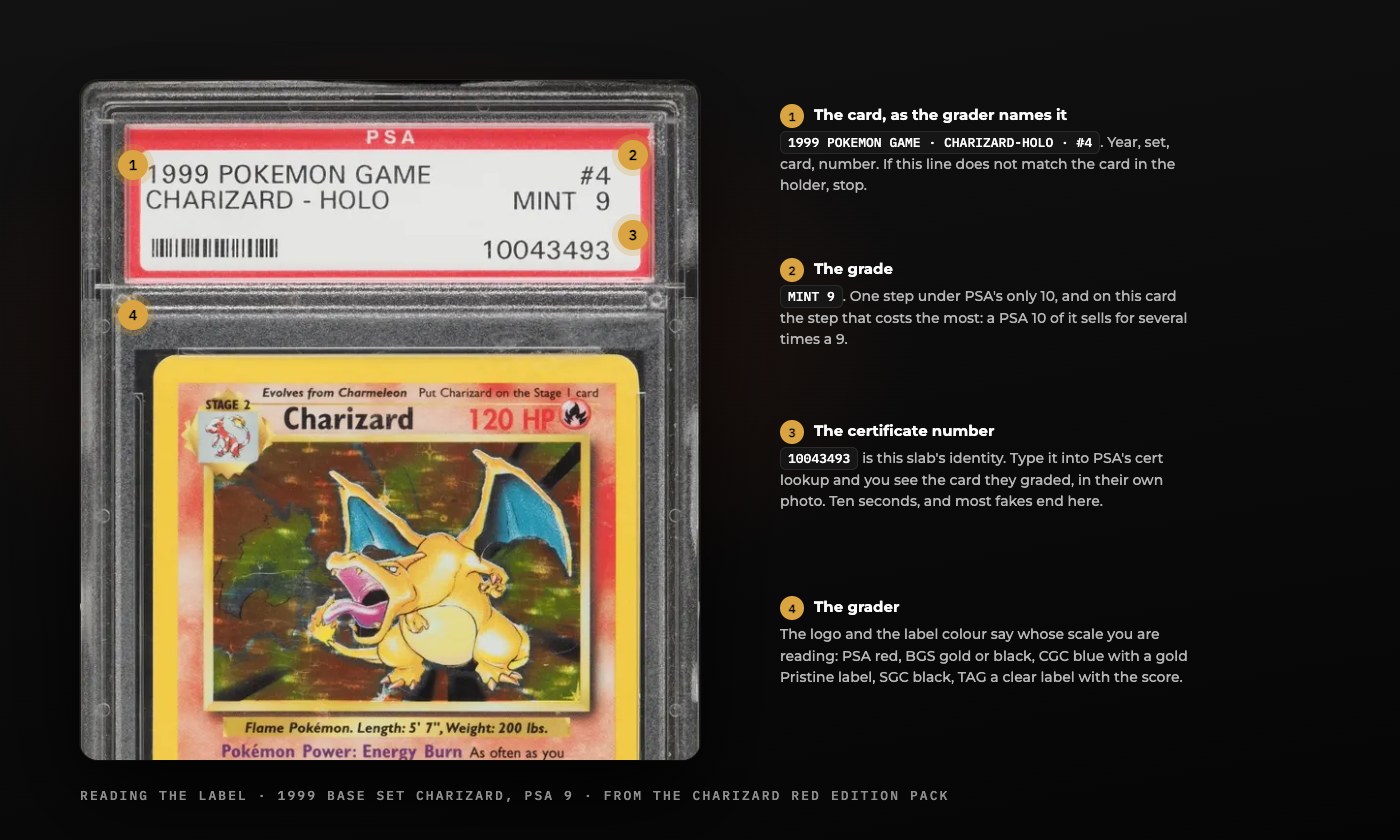
PSA: psacard.com → Verify. CGC: cgccards.com → Verify CGC Certification. BGS: beckett.com → Verify. SGC and TAG: the cert lookup on their sites; TAG’s opens the full scan report.
Which grading company is best for Pokémon cards?
There is no best, there is a buyer. PSA slabs sell fastest and set the comps, which is why most of the cards in our packs are PSA. A BGS Black Label or a CGC Pristine 10 is a rarer thing and the right buyer pays for it. TAG gives you the most information per slab. If you are grading your own cards, grade for the market you will sell into, not for the label you like.
Grading FAQ
- Is a PSA 10 the same as a CGC 10?
- No. PSA has one 10. CGC has Gem Mint 10, close to PSA’s rule, and Pristine 10 above it, which needs 50/50 centering and a flawless surface at 10× magnification.
- Does PSA give a 9.5?
- No. PSA’s half grades run from 1.5 to 8.5; 9 and 10 are whole grades. BGS, CGC and SGC do grade a 9.5.
- What is a BGS Black Label?
- A BGS 10 whose four subgrades, centering, corners, edges and surface, are all 10. It is the rarest label of any grader.
- What does Gem Mint mean?
- The top everyday grade at PSA (10), CGC (10), SGC (10) and BGS (9.5): a card that looks perfect to the eye and nearly perfect under magnification.
- How do I check if a graded card is real?
- Type the certificate number on the label into the grader’s own cert lookup. It shows the card they graded, with their photo. A label whose number returns another card, or nothing, is not that grader’s slab.
- Which grading company is best for Pokémon cards?
- For resale, PSA sets the price references and sells fastest. BGS Black Label and the Pristine 10s of CGC and SGC are rarer and can sell higher. Grade for the market you will sell into.